




Restaurants Certification
Serving seafood from certified sources and keeping it traceable from supplier to plate. Reducing food waste, improving water and energy efficiency, and respecting workers’ rights.
About the certification
Friend of the Sea restaurant certification assesses seafood sourcing alongside the practices used to receive, store and serve it. It also covers staff training, working conditions, menu options, resource use and waste management.
Restaurants, takeaway outlets and catering chains can apply for the locations and activities they want assessed. Diners can check the approved outlet and seafood scope, while operators can understand the purchasing records and operational evidence needed.
What can be certified
Assessment covers the named restaurant or catering locations, seafood products and relevant supply-chain activities. For a group, the included locations must operate under the same documented management system. Approval does not automatically extend to every outlet or mean that every dish is made entirely from certified ingredients
What the standard covers
The assessment connects seafood purchasing records with the way the restaurant stores, prepares and serves food.
At least 90 percent of seafood served, measured by product count or alternatively by total weight, must carry an accepted certification. At least 60 percent must be certified by Friend of the Sea or GLOBALG.A.P., and at least one species must be Friend of the Sea certified.
All tuna sourced must be approved as Dolphin Safe by Earth Island Institute. Purchasing records must support the origin and status of the tuna used.
Products and batches must be uniquely identified and linked to their sources, including fishing area and method or aquaculture site. Controls must prevent mixing certified and uncertified products. The audit traces at least one product back to its certified supplier.
Staff involved in traceability receive training at least annually. The traceability system and recall procedure are tested every year. Records are retained beyond the product’s shelf life and the interval between audits.
Checks cover child labour, minimum legal wages, health care, workplace safety and non-discrimination. Evidence includes employment records, risk controls, staff training, protective equipment and arrangements for emergencies.
Vegan dishes must be listed and highlighted on the menu, with at least one fruit dish available. Vegetable-led dishes, balanced portions and calorie or nutrition information are additional recommended measures.
Operators record water and energy use over time, implement efficiency measures and train kitchen and front-of-house staff. They use renewable energy with a plan to increase its use. Cleaning-product selection is also assessed for environmental suitability.
Waste facilities must be labelled for sorting recyclable materials, and plastic waste must enter appropriate recycling arrangements. Single-use plastic is prohibited.
Operators manage purchasing and food flows to reduce food waste and eliminate disposal to landfill. A plan must provide for a partnership within 12 months with an NGO distributing unused food to people in need. Wider community support activities are recommended.
Assessment and certification
The audit checks seafood purchasing and supplier evidence, traceability, working conditions and relevant restaurant practices. It includes a product traceability test and review of the locations covered by the application.
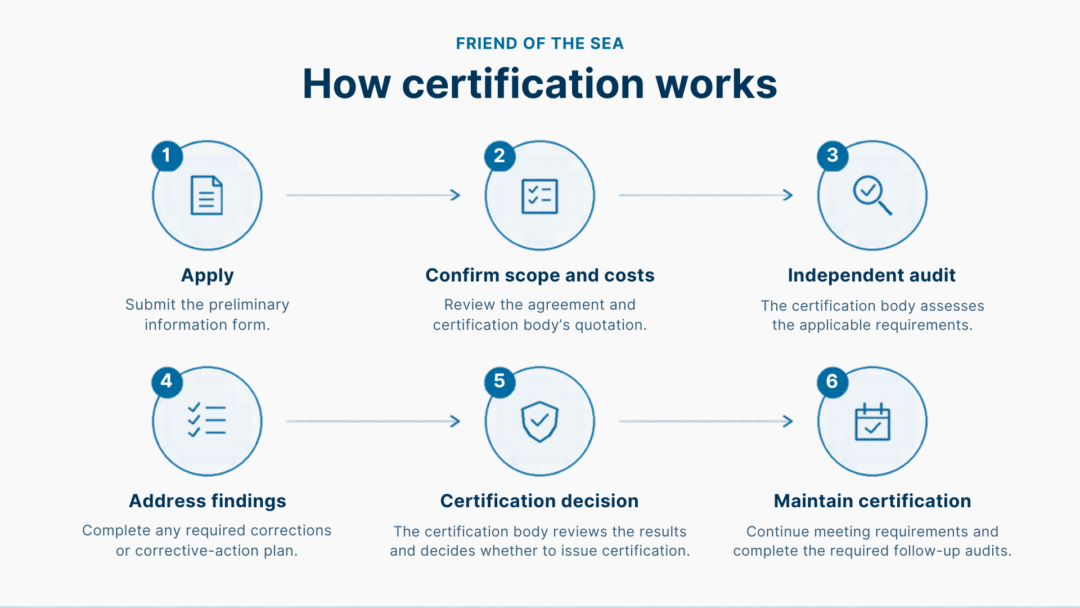
Certification fees
Request a quotation for the outlets, catering activities and seafood scope you want assessed. Confirm the audit charges and applicable logo-use fees before proceeding. Group applications should identify each location and the shared management arrangements.
Check certification status
Check the relevant product or outlet, its approved scope and current status. A business name in the directory does not mean every product or activity is covered.
Frequently asked questions
No. The restaurant must also meet the 90 percent and 60 percent seafood-sourcing thresholds and the operational criteria. At least one Friend of the Sea certified species is only one part of the assessment.
They are calculated using the number of seafood products served or, alternatively, their total weight. Provide purchasing and supplier records so the auditor can verify the calculation and certification status.
No. The seafood thresholds concern seafood products. Restaurant approval is not a claim that every ingredient on the menu is certified.
Yes. Identify the locations included and provide evidence that they operate under the same management system. Other outlets are not automatically included.
No. Your restaurant’s application and scope must be approved, and logo use must be authorised. A supplier’s approval does not grant logo rights to your outlet.
Prepare seafood purchase records, supplier certificates, species and origin information, menus, traceability and recall tests, staff training, water and energy records, waste arrangements and employment evidence.
Apply for certification
Provide the restaurant or catering locations, seafood species and suppliers, and the activities you want assessed. Include any shared storage or distribution facilities that handle the products.