



Omega-3 Certification
Raw materials from certified fisheries or aquaculture in compliance with labor rights.
About the certification
Friend of the Sea Omega-3 certification assesses defined oils and supplements against the applicable sourcing, traceability and social requirements.
Certification applies to the defined products or species in the approved scope. It does not certify the organisation as a whole or automatically cover everything it sells. Audits check the relevant production activities and evidence needed to establish product compliance.
What can be certified
Suppliers, processors and end brands can apply for specified Omega-3 oils and supplements. Fish-based products are assessed using the combined chain-of-custody and fish oil/Omega-3 standard. This allows the specified by-product routes as well as certified fishery or raw-material sources. Marine-source assessments depend on the species and how the raw material is obtained.
What the standard covers
The topics below summarise the combined Chain of Custody and fish oil/Omega-3 revision 5 checklist. Source fisheries and aquaculture are assessed under their applicable standards.
Each product and batch must be uniquely identified. The traceability system must prevent certified product from being mixed or substituted with non-certified product.
Requirements 1.1-1.2.
The organisation must document product origin, including the vessel, fishing area and gear for wild material, or the country of origin and production method for farmed material.
Requirement 1.3.
Employees handling chain of custody must receive training at least annually. The traceability system must be checked at least annually, and a product-recall procedure must exist and be tested at least annually.
Requirements 1.4-1.6.
Applicable chain-of-custody requirements must be met by subcontractors. Compliance records must be retained beyond both the certified product shelf life and the interval between audits.
Requirements 1.7-1.8.
Requirements address child labour, legal minimum wages, access to healthcare and workplace safety. SA8000 certification is a recommendation.
Requirements 3.1.1-3.2.
Genetically modified organisms are prohibited for fish feed, fishmeal, fish oil and Omega-3 products covered by this section of the standard.
Requirement 4.1.
Fish feed, fishmeal, fish oil and Omega-3 ingredients must come from the source categories specified in the standard: fish by-products from processing or aquaculture and/or discards; Friend of the Sea-certified fisheries or fleets; or Friend of the Sea-certified raw-material suppliers.
Requirement 5.1. The auditor lists suppliers and collects evidence for the applicable source route.
Fish by-products must not come from species listed as Vulnerable or worse on the IUCN Red List.
Requirement 5.2.
The audit includes a traceability test covering at least one finished-product batch from beginning to end. Evidence includes suitable mass balances, bills, invoices and documents demonstrating origin and conformity.
Traceability Test section, rev. 5 page 13 of the PDF.
This is a summary. The full applicable standard defines the requirements and evidence. Essential and Important criteria follow the corrective-action rules set out in the standard; recommendations are not compulsory for certification.
Independent certification and international recognition
An independent certification body assesses compliance with the applicable product requirements. Friend of the Sea is listed as an endorsed scheme by Global Accreditation Cooperation Incorporated (Global ACI). This is scheme-level recognition, not a separate endorsement of every product.
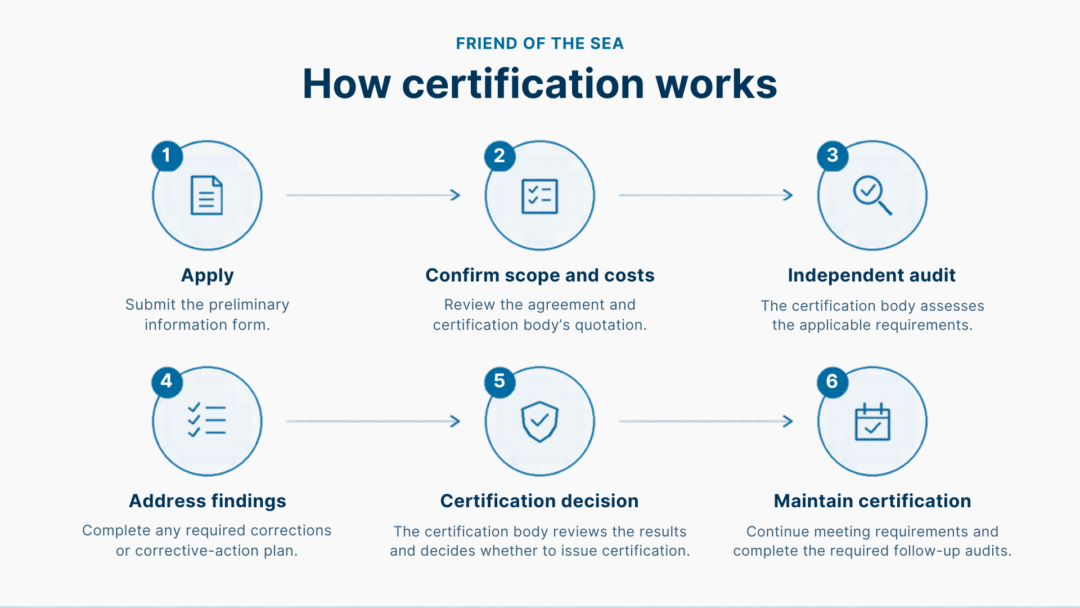
End-brand audits are based on documentary evidence for the products to be certified, including supplier certificates, product information and traceability records. Producers and processors are assessed against the requirements relevant to their production activities. A brand that also manufactures or processes products must include those activities in its assessment.
Certification fees
Suppliers and end brands use the same published price list. The applicable fee depends on the relevant category, revenue band and products or species covered; using the same list does not mean every applicant pays the same amount.
The price list shows annual royalties for new contracts. Audit costs are quoted separately by the certification body. VAT is additional where applicable.
Standards and supporting documents
Supporting documents
Check certification status
Search the directory for the relevant product or species and check its certification scope and status. A company name in the directory does not mean that all its products are certified.
Frequently asked questions
Certification applies to the defined products or species in the approved scope. It does not certify the organisation as a whole or automatically cover everything it sells. Audits check the relevant production activities and evidence needed to establish product compliance.
End-brand audits are based on documentary evidence for the products to be certified, including supplier certificates, product information and traceability records. Producers and processors are assessed against the requirements relevant to their production activities. A brand that also manufactures or processes products must include those activities in its assessment.
Yes. An end brand must pay the applicable Friend of the Sea logo royalties and obtain authorisation to use the logo, even when its supplier is already Friend of the Sea certified. Supplier certification does not transfer logo-use rights to the brand. Only the approved products may carry the logo.
No. Both use the same published price list. The applicable category and fee calculation determine the amount payable. Audit charges are separate.
Yes. The combined standard permits specified fish by-products from processing or aquaculture and discards. By-products must not come from species listed as Vulnerable or a higher threat category on the IUCN Red List.
The Omega-3 programme page includes krill and algae as sources. Their source assessment is different from the fish-by-product route: wild harvesting requires the relevant source assessment, while seaweed and algae have a dedicated checklist. Certification is specific to the approved product and source; the fish oil checklist alone does not establish certification for every marine ingredient.
No. Certification for plant-based Omega-3 oils from agricultural sources is addressed by Friend of the Earth.
No. The finished product must be included in the approved scope. An end brand submits documentary evidence linking the product to the certified source and obtains its own logo-use authorisation.
Apply for certification
Tell us the Omega-3 products and brands you want certified, their raw-material species and sources, and whether you are a supplier, processor or end brand.
The preliminary information form is confidential and does not commit you to proceeding.