





The skincare industry has grown significantly in recent years, bringing an ever-expanding range of products, elaborate routines and promises of quick results. Yet consumers are increasingly questioning complicated beauty routines, cosmetic ingredients and their potential environmental impact, from persistent synthetic substances to packaging waste.
These concerns inspired sisters Cathy and Angela to create Food for Skin, a Dutch skincare brand built around a simple idea: skincare should be effective, straightforward and considerate of both people and the environment. They develop their own formulations using natural bioactive ingredients, focusing on simple routines that support the skin barrier.
Fewer Steps, Better Products
Rather than adding more products to the bathroom shelf, Food for Skin focuses on doing more with less. Cathy and Angela believe a good routine doesn’t need ten steps. A few well-formulated products that support the skin barrier, the skin’s protective outer layer that helps retain moisture and keep out irritants, are often enough.
Each product is therefore developed to have a clear role in a short routine: cleansing, nourishing and protecting. Fewer steps mean fewer products layered on the skin, less product used and less packaging thrown away.
That same idea of doing more with less shapes how the brand selects its ingredients. Where possible, Food for Skin works with upcycled ingredients: raw materials made from by-products of the food industry that would otherwise go to waste. Its avocado oil, for example, comes from damaged avocados that are not good enough to be sold as fruit. Seeds left over from food and juice production are pressed into oils such as pumpkin, cucumber, elderberry and raspberry seed oil. These oils are rich in fatty acids that help nourish the skin and support its natural barrier.
This attention to ingredient selection also extends to sun protection, alongside a commitment to protecting marine ecosystems.
The Friend of the Sea certification
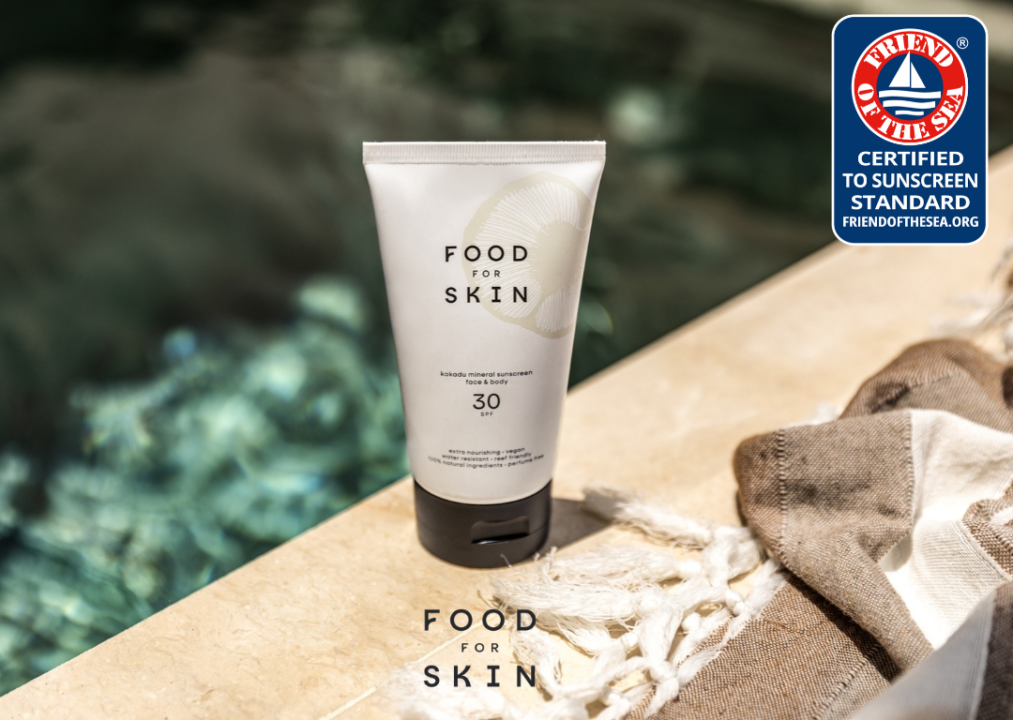
Food for Skin’s mineral SPF 30 sunscreen has earned the Friend of the Sea Sunscreen Certification, which sets specific requirements intended to reduce the potential environmental impact of sunscreen products.
Friend of the Sea is a project of the World Sustainability Organization (WSO), providing certification of products and services which respect the marine habitat and aquatic species, with audits carried out by qualified auditors of independent and nationally accredited certification bodies.
The Friend of the Sea Sunscreen Certification focuses particularly on potential risks to marine ecosystems. Its standard prohibits certain chemical UV filters, including oxybenzone and octinoxate, which have raised concerns over their effects on coral health, growth and reproduction. It also establishes requirements for water resistance, restricts certain nanoparticles and limits spray formulations that may disperse substances into the surrounding environment.
Food for Skin’s SPF 30 sunscreen uses non-nano zinc oxide, a mineral UV filter, alongside plant-derived ingredients such as grape seed oil, Kakadu plum seed oil, bilberry seed oil and raspberry seed oil. The formula contains no added fragrance or synthetic organic UV filters. It is water-resistant and comes in a tube made from 100% post-consumer recycled plastic.
In July 2026, Food for Skin also topped the ranking of Dutch sunscreen brands in the Just Enough Product Guide, which assesses brands against environmental and social criteria.
With Friend of the Sea certification, Food for Skin takes its commitment to responsible skincare one step further, extending its attention to ingredients and product development to the potential impact of sun protection on marine ecosystems.